
December 1, 2025 · From Tom's Substack
America’s Not-So-Inevitable Greatness in Science
When I was growing up, my father wanted me to learn German. He had come of age when German was the language of science and when Vienna and Berlin were home to many of the world’s leading physicists, chemists and medical researchers. But by…

Dr. Tom Insel
4 min read
When I was growing up, my father wanted me to learn German. He had come of age when German was the language of science and when Vienna and Berlin were home to many of the world’s leading physicists, chemists and medical researchers. But by the middle of the 20th century, he should have realized that the Nazi project to make Germany “great again” had decimated scientific leadership—not for lack of investment, but because science was conscripted into a political ideology.
By the time my own children were growing up, English had become the global language of science, and the United States—fueled by postwar investment and immigration—had become the undisputed home for discovery.
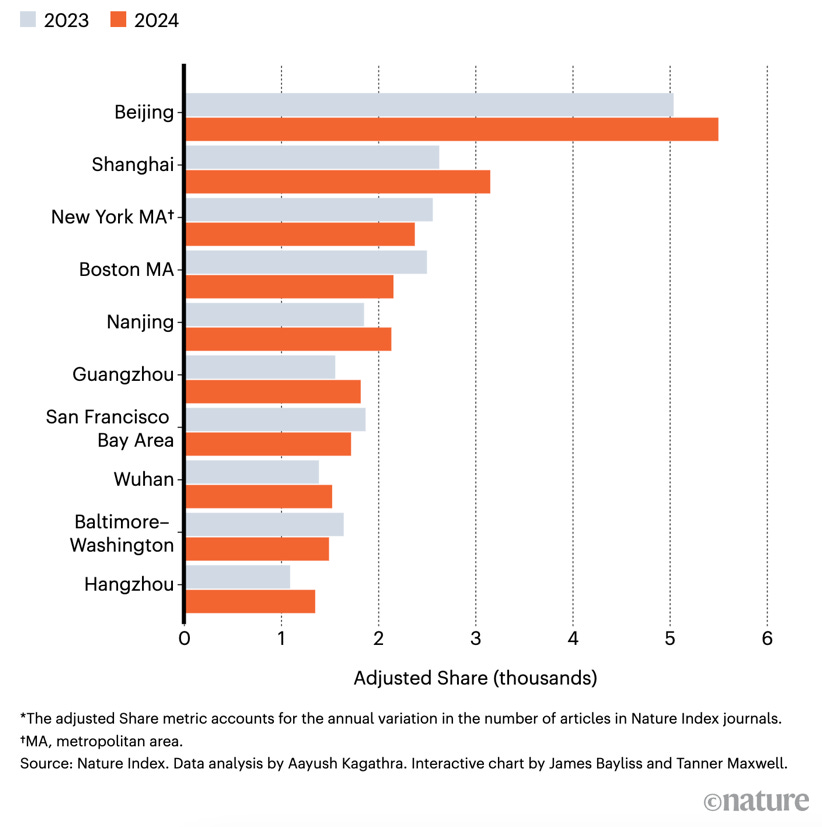
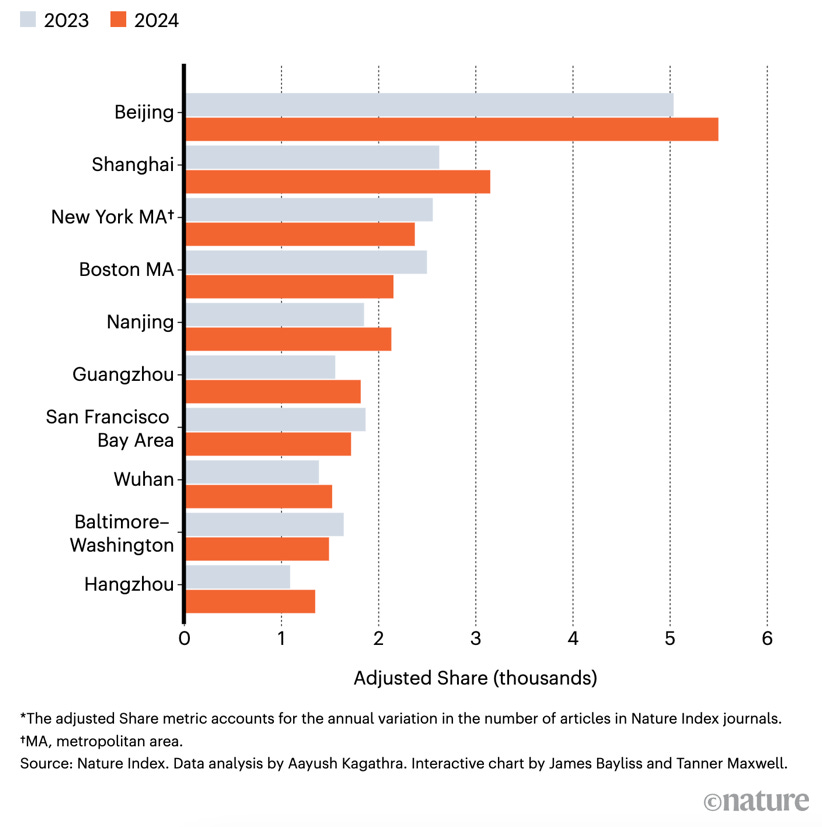
My grandchildren, however, are entering a different world. China now publishes more papers in chemistry and the physical sciences and is closing the gap in the biological sciences in Nature and Science, the two most prestigious scientific journals.(see Nature Index at www.nature.com) I’m not sure my grandchildren will need to learn Mandarin because in the 21st century the key to scientific innovation may be less about language than about location. Science is inherently social. Breakthroughs come from hubs—places where people argue, collaborate, and push against prevailing paradigms. Einstein may have upended physics while working as a patent clerk in Bern, but in an era of quantum computing and deep data, revolutions are unlikely to happen in isolation.
So where is great science happening now? This chart, from Nature Index published on Nov 15, tells a clear story: China’s scientific centers have climbed steadily, surpassing many American hubs and the trend from 2023 to 2024 does not favor U.S. science.
In 2010, I visited the Institute of Neuroscience in Shanghai and saw the early signs of this shift. Students packed my Saturday morning lecture and challenged every assumption I made about brain circuits and behavior. Their interruptions were not rude; they were exhilarating. Later, when I wandered into the Institute’s library and found shelves devoted to poetry, philosophy and art, I realized that China’s rise would not be driven by rote learning but by curiosity, breadth and ambition. America’s scientific primacy already felt less secure.
Fifteen years later, the consequences are visible. China has spent decades investing relentlessly in education and research. America, meanwhile, is rapidly undermining its own scientific infrastructure—gutting federal agencies, politicizing public health, and attacking universities that once fueled our scientific engine.
During a recent visit to EPFL in Lausanne—one of Europe’s top scientific institutions—faculty told me they’re seeing an applicant surge unlike anything in their history. For a single neuroscience opening, they received 350 applicants, including many tenured professors from the United States willing to give up tenure to join a European lab. They weren’t gloating, but they were not exactly surprised.
America’s scientific leadership is often treated as if it were inevitable. It wasn’t. For most of our 250-year history, we were not a scientific powerhouse. Yes, there were Franklins, Edisons, Bells and Morgans—but the nation did not lead the scientific world until after World War II. That rise came from choices:
· the Vannevar Bush report that spurred creation and growth of the National Institutes of Health;
· the national mobilization after Sputnik that expanded scientific education;
· and the welcoming of immigrants whose genius transformed our labs, companies and universities.
Together, those policies turned the second half of the 20th century into America’s golden age of scientific discovery, with enormous economic and social dividends.
As Nicholas Kristof recently wrote, it was investment in science and education (as well as the embrace of immigrants) that made America great—not slogans, nostalgia or political theater. Those forces once made Germany great. They may now be making China great.
For my grandchildren, innovation may soon be something the United States imports rather than exports. And if that happens, it won’t be because Americans lost talent or ambition. It will be because we allowed our scientific infrastructure to erode through complacency, short-term budgeting, and culture-war theatrics aimed at our own universities.
Reversing this trajectory requires more than hand-wringing. It requires the same clarity of purpose we demonstrated after World War II and after Sputnik. We need a renewed national compact around science that includes:
· Doubling federal research funding over the next decade, particularly in emerging fields like AI, synthetic biology, and quantum engineering.
· Depoliticizing federal science agencies so that public health, climate research and biomedical science are not whipsawed by election cycles.
· Restoring America’s immigration pipeline for STEM talent, from graduate students to established scientists, making the U.S. once again the most attractive place on earth to build a scientific career.
· Reinvesting in public universities—the engines of upward mobility and scientific discovery—before they are hollowed out by disinvestment and ideological attack.
· Strengthening K–12 science and math education, especially in communities where opportunity has withered.
In other words: we need the courage to do what worked. Science does not thrive on nostalgia; it thrives on commitment, investment and openness.
In 1990, I had a gifted German scientist join my lab at the NIH. Reflecting on why he left home to work with our team in America, he noted that, “It’s easy to become not great again.” He meant it as a caution. Today, it reads like a national warning label.